
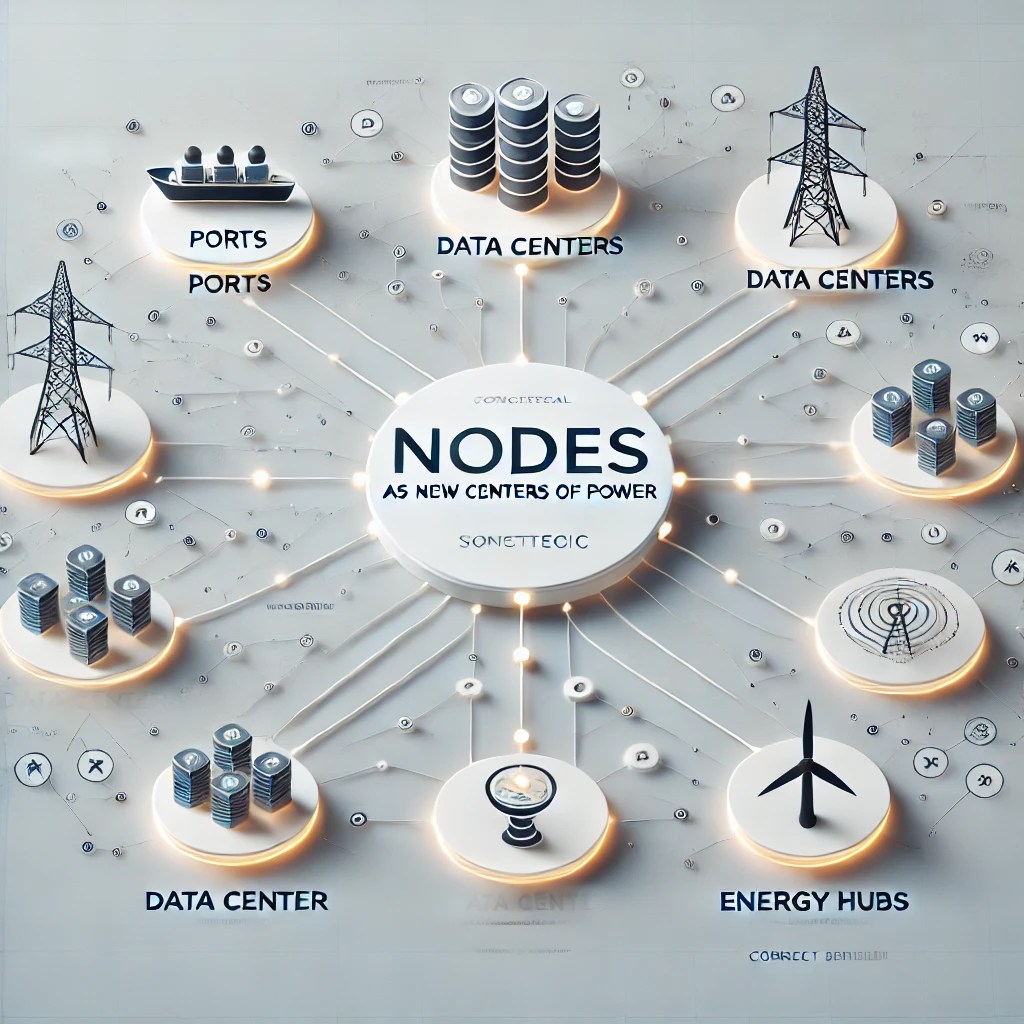
“A new systemic approach: The ‘Node’ and the ‘Collapse’ – Where power concentrates, when traditional geography no longer holds”
Introduction – The Silent Collapse
In official narratives, the European Union appears as a space in crisis but still solid: shaken by geopolitical tensions, internal inequalities, and social unrest, yet equipped with institutions, treaties, cohesion plans, and formal democratic legitimacy. And yet, beneath this surface, something deeper is unfolding: a crisis of representation, preceding the crisis of legitimacy.
Power – in its operational form – no longer concentrates where we look for it. Not in Parliaments. Not within national borders. Not in traditional redistribution mechanisms. It has shifted into flows: of capital, data, energy, people, goods. And it organizes itself in nodes (Castells, 1996; OECD, 2022).
Institutional politics, however, continues to rely on a a static conceptual map built for a different century. , built upon twentieth-century categories: territory, sovereignty, law, belonging. This is where collapse emerges – not due to external enemies, but because the very lens through which we interpret power has fallen behind its real morphology (European Commission, 2020; ForumDD, 2022).
Flows as the new field of Power
European democracies were built on a territorial logic: those who control a territory administer it; those who represent its citizens regulate its resources; those who govern space exercise sovereignty.
But today, space alone no longer explains power. The world is crossed by flows – of data, energy, capital, bodies, and material and symbolic goods – that do not move according to administrative maps, but along invisible or privatized infrastructures (Easterling, 2014; ECFR, 2021).
Those who govern these flows do not need to engage in politics. It is enough to control a node (World Bank, 2021; Global Infrastructure Hub, 2020).
A strategic port (like Piraeus), a segment of undersea cable, an energy hub in North Africa, a logistics algorithm, a cloud computing backbone hosted by a tech company.
These are the new command centers, even if they do not appear in public law textbooks. China has understood this well with the Belt and Road Initiative: its expansion is not about annexing borders, but about securing nodes. The United States does so through digital platforms and the ability to block or redirect global information flows. Even NATO, in its most recent documents, highlights the vulnerability of interconnected civilian infrastructures.
The European Union, by contrast, continues to see itself as a normative space, but does not act as an infrastructural subject of flows. It loses ground because it fails to recognize the battlefield – and when it does, it is often too late or too slow.
What are “Nodes” (and why no one governs them)
A node is a point where flows concentrate, are filtered, or transformed. It is not a physical place in the traditional sense, but a geopolitical function: an interface that allows data, energy, capital, or goods to pass through, to be monitored, encounter friction, or flow freely.
Concrete examples:
• The Port of Piraeus (Greece), now 67% controlled by Chinese company COSCO, is a strategic Euro-Asian logistics node (UNCTAD Port Performance 2023).
• Submarine data cables, like BlueMed or Meta’s 2Africa, carry 98% of global internet traffic (OECD, 2022).
• Energy hubs in Tunisia, Algeria, and Mozambique are under strategic scrutiny by ENI and the EU for post-Russian gas supply security (European Commission, REPowerEU, 2023).
• European data centers, often owned by U.S. or Chinese companies, manage sensitive public and private data without full legal sovereignty (EPRS, European Parliament, 2022).
The paradox is that these places determine access and power but escape public governance radar. They are often:
• privatized,
• transnational,
• or managed by opaque actors (joint ventures, sovereign funds, Big Tech).
Moreover, taxation is minimal or nonexistent. Those who intermediate high-value flows are not subject to taxation proportional to the power they exercise. And those who should regulate these nodes – States, the European Union, multilateral agencies – have not yet built adequate tools to do so.
Current governance, born to protect territories and citizens, is not equipped to regulate what is constantly in motion.
Democratic crisis as a result of disconnection
In the last ten years, European democracies have faced an evolution of political unease that goes beyond electoral instability or abstentionism: it is a systemic disconnection between citizens and power structures.
The data confirms it:
• 2019 European elections: 50.6% turnout, with strong territorial disparities (European Parliament).
• France, legislative elections 2022: over 53% abstention in the first round (Ministère de l’Intérieur).
• Italy, general elections 2022: 63.9% turnout, historical low (Italian Ministry of the Interior).
At the same time, the political forces gaining the most support are those that simplify flows: they block, filter, select. Fluid right-wing movements do not offer a territorial project: they offer emotional interfaces to citizens already immersed in a fluid reality they do not understand.
Citizenship does not disappear: it is reformulated. It becomes intermittent, selective behavior, reactive to flows. But the State continues to see it as a fixed, resident, representable subject. The result is a crisis not of participation, but of structural recognition.
The “Node Theory” as an “alternative Map”
If power is no longer distributed by territory, and citizenship is no longer organized in stable classes or affiliations, then governance must also change its map.
The Node Theory arises from this observation: the node is the new political unit of the present.
Governing through nodes means:
1. Mapping and classifying critical nodes
TEN-T, EU cybersecurity, digital sovereignty: these are partial attempts, but there is no integrated governance model.
2. Taxing and redistributing intermediation
Taxation must target those who intermediate flows, as in the OECD models of minimum taxation for global corporate groups.
3. Reconnecting citizens to local nodes
Ports, data centers, and energy communities must become democratic nodes, not just functional structures.
The Node Theory is not a technocratic utopia. It is a concrete political proposal for a new democratic pact within intermediate economies. It is an operational framework to read crises and design new forms of adaptive citizenship.
Conclusion: “If Not Now, When?”
The EU still has time to adapt. But a change of coordinates is needed. The Node Theory does not call for revolution, but for attention. It is a lens to read the present – and a proposal for those who wish to or those who wish not only to understand the present, but to inhabit it with justice and vision.
What about your voice?
See ya’,
Gala & Synéktika
(All contents of this article are protected by copyright and reflect original elaboration. Reproduction, even partial, without the author’s permission is prohibited)


 Eudemonia©
Lascia un commento