
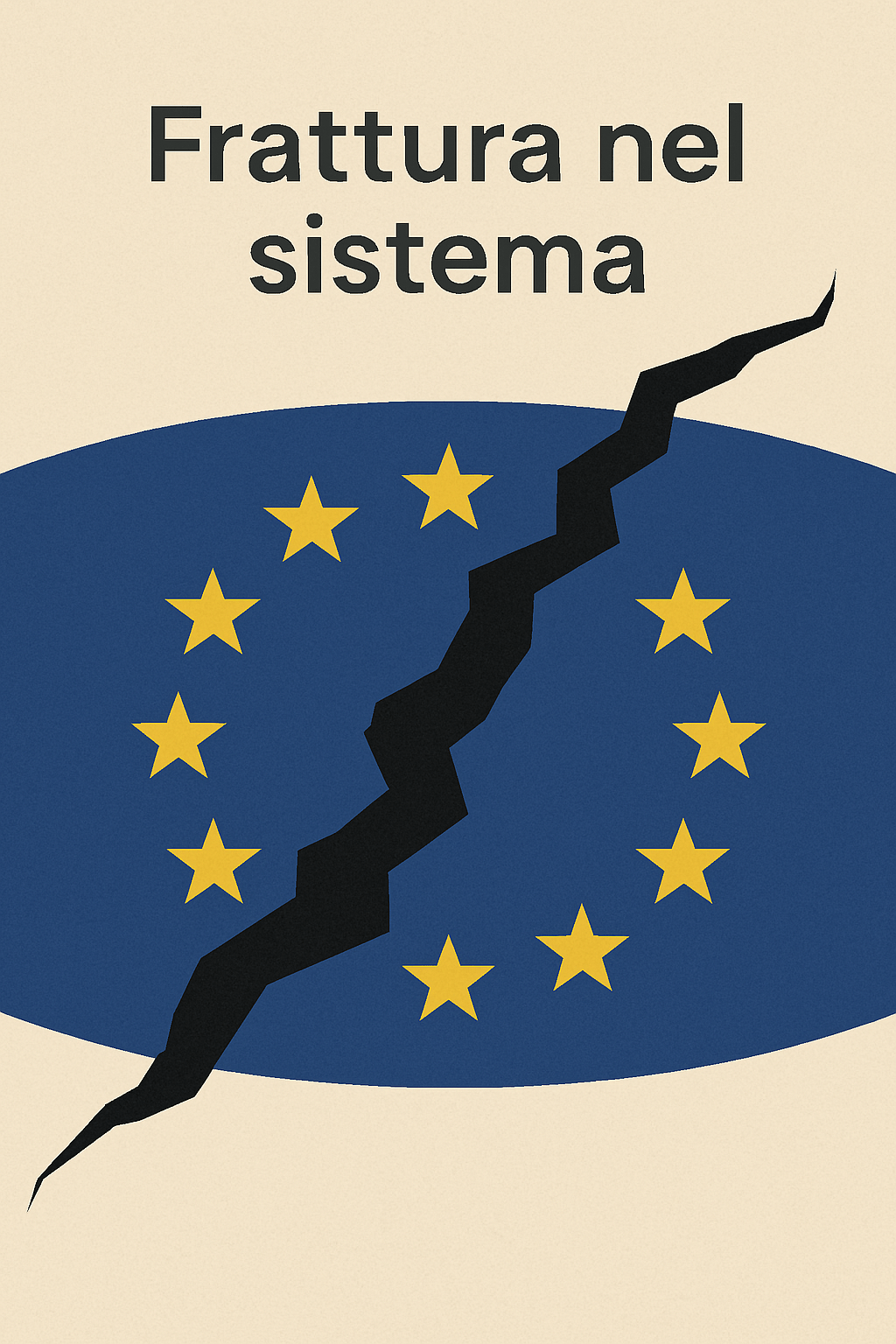
“Fracture and Breach: beyond federalism and differentiation, toward a geopolitics of flows”
Introduction – Europe in fracture: Federalism, Differentiation and the rise of Flows
The European Union stands at a critical juncture – not only due to the accumulation of systemic crises, but because of the growing inadequacy of the analytical categories used to interpret them. While public debate continues to swing between the federalist utopia and the tactical practice of differentiation, geopolitical reality seems to run on entirely different tracks: those of flows.
The EU crisis, already exposed during the great recession of 2008 and exacerbated by events such as pandemic management and recent geopolitical tensions, has shown that the resilience of the European project is no longer played out solely in the balance among Member States, but rather in its ability to embed itself in – and compete within – the new global corridors: infrastructural, energy-related, digital, logistical, and regulatory.
This is the central thesis: federalism and differentiation are symptoms of a static system trying to adapt to a fluid world. The real key is not to decide who governs, but to understand how flows move and intersect.
Today, Europe is traversed – and often bypassed – by alternative corridors such as China’s Belt and Road Initiative, the Eurasian Middle Corridor, south–north energy routes through the Mediterranean, and global regulatory platforms (e.g. AI, ESG).
The current debate: A sterile confrontation
The debate on the reform of the European Union has historically revolved around two dominant theoretical models: federalism, which aims for deeper political union, and differentiation, which accepts and manages the reality of multi-speed integration. Both visions respond to institutional logics, but tend to overlook external transformations that redefine power in functional rather than territorial terms.
Federalism, though supported by historical figures like Altiero Spinelli and revived in critical phases, encounters obstacles linked to the resistance of Member States and internal fragmentation. Differentiation, on the other hand, presents itself as an adaptive strategy, visible in special regimes such as Schengen or the Eurozone, but with the risk of undermining overall cohesion.
Both options, when viewed in the current global context, appear as tools designed for an architecture of power that no longer exists. insufficient to explain and manage the new forms of transnational power that move along networks, corridors, and standards.
The logic of Flows: A paradigm “Shift”
In today’s context, power no longer concentrates solely in institutional centers but is distributed along flows – both material and immaterial – that cross borders and institutions. Flows of energy, data, goods, norms, and human capital now define the real trajectories of geopolitics.
Control over logistical corridors, digital infrastructures, energy nodes, and cognitive circuits has become a crucial dimension. For the EU to maintain centrality, it must conceive of itself not as a vertical union of States, but as a horizontal network of strategic connections to be strengthened and protected.
From this stems the proposal for a new interpretive paradigm: the geopolitics of flows.
The geopolitics of Flows: A new “Map of Power”
Power is now exercised through the ability to direct, regulate, or divert flows. Emerging actors – digital platforms, global cities, regulatory networks – occupy central decision-making spaces without necessarily passing through States. The EU already has tools to influence: just consider the GDPR, the Green Deal, the AI Act. But vision and strategic coherence are needed.
This new map of power privileges nodes (ports, data hubs, industrial zones), networks (transit routes, standardization platforms), and breaches (critical physical or regulatory passages). The challenge is to govern these elements in a coordinated and systemic way.
Proposals: Toward a European Networked Governance
1. Overcome the center-periphery logic: promote distributed poles, hub cities, and multilevel networks.
2. Invest in flows: resilient logistical, digital, energy, and cognitive infrastructures.
3. Build transnational alliances: based on connectivity, not just geographic proximity.
4. Integrate flows into policy design: adopt an adaptive, interconnected logic grounded in flow analysis.
The geopolitics of flows is not an abstract theory, but an operational lens to understand the world and act within it.
See ya’ to the next chapter!
Gala & Synéktika
(All contents of this article are protected by copyright and reflect original elaboration. Reproduction, even partial, without the author’s permission is prohibited)



 Eudemonia©
Lascia un commento