
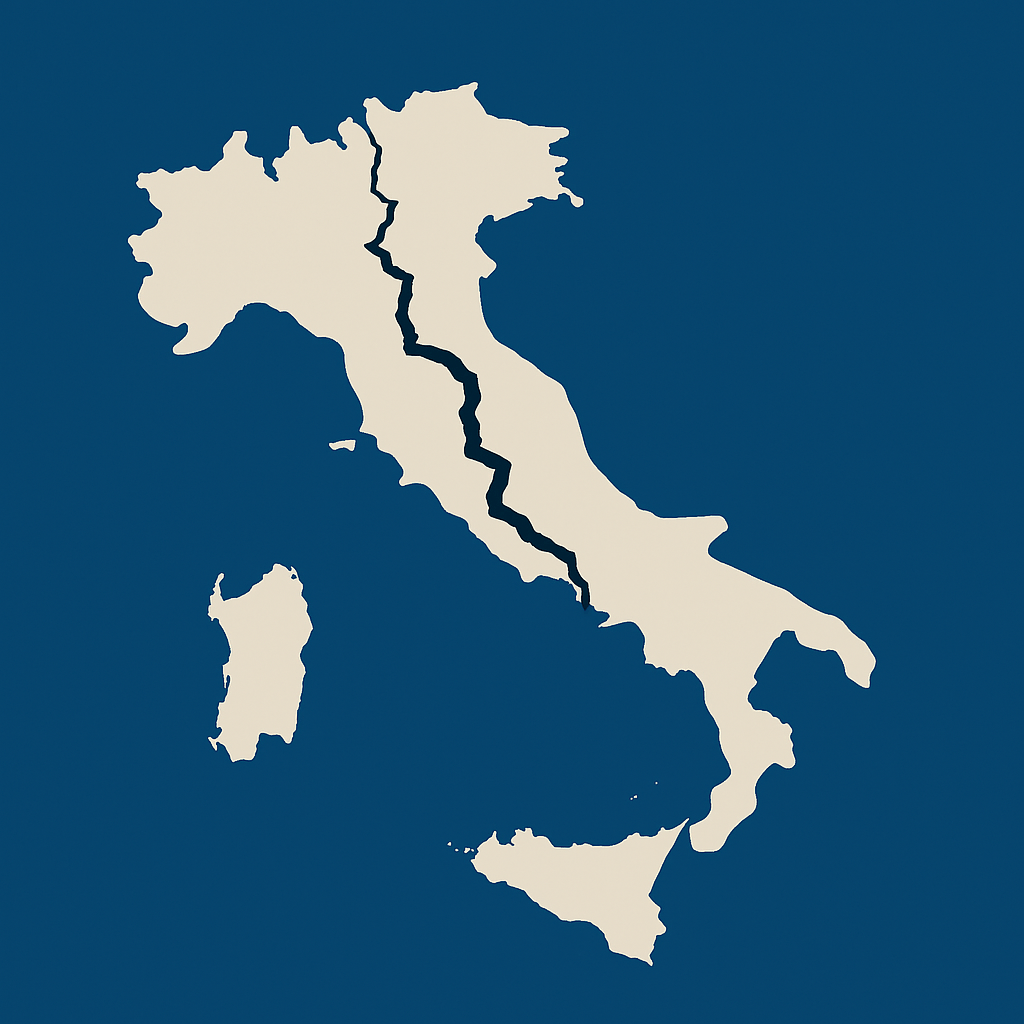
(ITA) Il nodo e la frattura: Perché l’Italia non regge più e cosa servirebbe davvero per non crollare
*(EN: For the English version of this article, please scroll down)*
C’è un’Italia che si sgretola in silenzio. Non per retorica, ma per gravità. Un ponte, una galleria, un argine, un tratto di ferrovia alla volta. Le crepe non fanno notizia fino al crollo, e anche allora sembrano sempre incidenti, mai sintomi.
Eppure non siamo un paese povero. Non siamo nemmeno un paese immobile.
Ma forse siamo un paese costruito su una mappa che non corrisponde più. Non corrisponde più al clima, ai flussi, ai ritmi, alle relazioni del presente. Abbiamo pensato lo spazio come qualcosa da “coprire”, da collegare con grandi assi, da connettere verticalmente. Ma il mondo oggi si muove in diagonale, in profondità, in nodi.
Abbiamo miliardi, piani, task force. Ma forse…la frattura non è nel terreno. È nel pensiero. E se il problema non fosse la quantità delle risorse, ma la forma con cui immaginiamo di usarle? E se la vera domanda fosse: è questa la strada giusta?
Il tempo del Piano (PNRR): molte risorse, poca struttura
Il Piano Nazionale di Ripresa e Resilienza è, sulla carta, una delle più grandi occasioni della storia repubblicana. 194 miliardi di euro, sei missioni, un orizzonte europeo condiviso. Eppure, a quasi quattro anni dalla sua approvazione, è stato speso meno di un terzo delle risorse disponibili: 58,6 miliardi su 194,4.
Nel solo 2024, a fronte di 42 miliardi pianificati, solo il 22,5% è stato effettivamente speso. E mentre i numeri si aggiornano, la sensazione resta: le opere si muovono più lentamente del contesto che le richiede.
Le ragioni sono molteplici: burocrazia, lentezze attuative, carenza di capacità progettuale nei territori. Ma c’è un punto che resta ai margini del dibattito:
come si distribuisce realmente la forza trasformativa di questi investimenti? E, soprattutto, secondo quale logica spaziale?
Cosa succede, oggi, se una grande infrastruttura viene realizzata in un punto non più strategico? Cosa succede se si insiste su un asse che non tiene conto della trasformazione climatica del territorio? Queste domande non sono teoriche. Sono topologiche. E forse è da lì che dobbiamo ripartire.
La frattura invisibile: l’Italia di oggi su strutture del passato
In Italia, molte infrastrutture chiave sono nate nel secondo dopoguerra.
Viadotti, dighe, scuole, acquedotti, ferrovie: un’ossatura pensata per un’altra epoca, con altri parametri, altri rischi, altri climi. Oggi quella stessa ossatura è vecchia, stressata, non ridisegnata.
Secondo l’ANSFISA, la metà dei ponti gestiti da enti pubblici ha più di 50 anni.
Alcune grandi dighe superano i 70. Molte scuole sono collocate in zone a rischio sismico senza adeguamenti. Gli acquedotti perdono più acqua di quanta ne riescano a distribuire in modo efficace. Eppure continuiamo a immaginare nuove opere sulla stessa logica delle vecchie. Aggiungiamo, ampliamo, sostituiamo. Ma non rivediamo il disegno complessivo.
È come se si pensasse che, con fondi a sufficienza, si possa riparare una geografia senza cambiarne la struttura. Ma il cambiamento climatico non negozia: intensifica, svela, moltiplica le crepe. E la vera domanda, allora, non è “quanto costa”. È: reggerà?
Il clima come moltiplicatore di stress e verità
Il cambiamento climatico non è più uno scenario: è il nuovo sfondo operativo.
Non accelera solo i fenomeni naturali, accelera anche le contraddizioni della nostra organizzazione territoriale. Una pioggia che ieri era gestibile, oggi diventa disastro. Un’estate in più prosciuga falde costruite su regimi idrici stabili. Un evento estremo mette in crisi sistemi progettati per un’altra normalità.
Non è solo questione di intensità, ma di inadeguatezza strutturale.
Abbiamo pensato le infrastrutture come apparati rigidi, lineari, stabili.
Ma oggi servono sistemi adattivi, flessibili, ridondanti, capaci di agire localmente in tempi rapidi. In questo contesto, il problema non è l’Italia.
Il problema è che continuiamo a immaginare lo spazio secondo modelli accumulativi, gerarchici, lineari. Come se il potere si distribuisse per prossimità al centro, e non per intelligenza connettiva.
Il clima, oggi, non fa solo danni. Fa emergere la mappa che usiamo. E ci chiede: è ancora quella giusta?
La “Teoria del Nodo”: un’altra geografia è possibile
E se non fosse una questione di centri da rafforzare, ma di nodi da attivare? La Teoria del Nodo non nasce per spiegare il passato, ma per orientare il futuro.
Un nodo è un punto d’intensità relazionale: si definisce per ciò che connette, non per ciò che domina. Un sistema nodale non cerca la grande opera: cerca la buona connessione. Non costruisce un asse, ma un ecosistema adattivo.
Non impone priorità verticali, ma distribuisce intelligenza operativa nei punti giusti.
Esempi concreti?
– Comuni montani che diventano snodi di protezione climatica, con microcentrali idroelettriche e hub civici di emergenza.
– Reti idriche decentrate, capaci di agire localmente quando la grande infrastruttura fallisce.
– Sistemi educativi territoriali che si legano a università, biblioteche, makerspace e cooperative, creando nodi di sapere.
– Infrastrutture “morbide”: centri di raccolta dati climatici, foreste urbane, sensori distribuiti, piattaforme digitali di prossimità.
In questa logica, il PNRR potrebbe diventare un’infrastruttura liquida, non più solo una griglia di progetti, ma una rete viva, connessa, reattiva. Un Piano che investe in resilienza distribuita, non in centralità predefinite. Non si tratta di immaginare tutto da capo. Si tratta di ripensare il modo in cui leggiamo lo spazio. E forse, da questo punto di vista, l’Italia ha già le condizioni ideali: territori diversi, culture locali forti, intelligenze civiche. Quello che manca è la mappa per farle dialogare.
Una domanda al lettore silenzioso
Non serve più aggiustare. Serve rivedere la forma del pensiero che guida l’azione. La frattura che osserviamo nei territori non è solo geologica o climatica. È cognitiva. È politica nel senso più alto: riguarda le mappe con cui scegliamo di orientare il possibile.
E allora forse non dobbiamo più chiederci quanto investire, ma dove, come, con quale logica relazionale. Forse l’Italia può diventare un laboratorio europeo per nuove reti di resilienza, non perché sia più fragile degli altri, ma perché sa già cosa significa stare sul crinale. Il nodo non è solo una teoria. È una proposta di lettura, una grammatica topologica per chi intuisce che il futuro non sarà lineare. E che ciò che regge non è la forza, ma la connessione.
E se non fosse una questione tecnica? E se il vero nodo fosse la forma stessa del pensiero strategico europeo?
Saluti e al prossimo articolo,
Gala & Syn
(EN) PNRR and the Node Theory
The Node and the Fracture
There is an Italy that crumbles in silence. Not for rhetoric, but for gravity.
A bridge, a tunnel, a riverbank, a stretch of railway. Cracks don’t make the news until collapse and even then, they appear as accidents, not symptoms.
Yet this is not a poor country. Nor is it a static one. But perhaps it is a country built on a map that no longer corresponds. No longer corresponds to the climate, the flows, the rhythms, the relations of the present. We’ve conceived space as something to be covered, connected through great axes, structured vertically. But the world now moves diagonally, deeply, through nodes.
We have billions, plans, task forces. But perhaps…the fracture is not in the ground. It’s in the thinking. What if the issue is not how much we invest,
but how we imagine using it? And the real question is: Is this still the right map?
The Time of the Plan: Plenty of Resources, Little Structure
On paper, Italy’s National Recovery and Resilience Plan (PNRR) is one of the most ambitious undertakings in the country’s postwar history. €194 billion, six missions, a shared European horizon. And yet, nearly four years after its launch, less than one-third of the resources have been spent: €58.6 billion out of €194.4. In 2024 alone, only 22.5% of the €42 billion planned has been effectively allocated. While numbers are being updated, the sensation remains:
projects move slower than the context that demands them.
There are many reasons: bureaucracy, delays, lack of local planning capacity.
But one point remains overlooked: how is the transformative power of this funding actually being distributed? And above all, along which spatial logic? What happens if a major infrastructure project lands in a place that is no longer strategic? What if we persist along a route that ignores how climate has redrawn the ground? These are not theoretical questions.
They are topological. And maybe that’s where we need to begin again.
The Invisible Fracture: A Country Built on Outdated Structures
Much of Italy’s critical infrastructure was designed in the post-war decades.
Bridges, dams, schools, aqueducts, railways: an architecture built for a different era, with different risks, different climates, different assumptions. Today, that same infrastructure is old, stressed, left unrevised.
According to ANSFISA, half of Italy’s publicly managed bridges are over 50 years old. Some major dams are older than 70. Many school buildings are located in seismic zones, yet remain structurally unretrofitted. And aqueducts lose more water than they can reliably deliver.
Still, we continue to imagine new projects following the logic of the old ones.
We add, expand, replace. But we rarely redesign the underlying system. As if we believed that enough funding could repair a geography without ever rethinking its structure. But climate change doesn’t negotiate. It intensifies, reveals, multiplies the cracks. The real question, then, is not “how much will it cost?” It’s: will it hold?
Climate as Stress Multiplier and Revealer
Climate change is no longer a scenario. It is the operating background. It doesn’t only accelerate natural events it accelerates the contradictions of our territorial organization. A rainfall once manageable now becomes a flood.
One additional summer dries aquifers built on assumptions of regularity. A single extreme event overwhelms systems designed for a different normal.
This is not merely about scale it’s about structural mismatch. We built infrastructures as rigid, linear, stable apparatuses. But what we need now are adaptive, flexible, redundant systems, capable of acting locally in real time.
In this context, the issue is not Italy. The issue is that we still imagine space according to accumulative, hierarchical, linear models. As if power flowed by proximity to the center, rather than through connective intelligence. Climate doesn’t just damage. It reveals the map we’re using. And it asks: is this still the right one?
The Theory of the Node: A Different Geography is Possible
What if the point were not to reinforce centralities, but to activate nodes? The Theory of the Node isn’t meant to explain the past, but to orient the future. A node is a point of relational intensity it is defined by what it connects, not by what it controls. A nodal system doesn’t seek the grand project: it seeks the meaningful connection. It doesn’t build an axis, it builds an adaptive ecosystem. It doesn’t impose vertical priorities, it distributes operational intelligence where it’s needed.
Concrete examples?
– Mountain municipalities as nodes of climate resilience, with micro hydroelectric hubs and civic emergency centers.
– Decentralized water systems capable of local response when major infrastructure fails.
– Territorial education systems linked to universities, libraries, makerspaces, cooperatives — forming nodes of knowledge.
– “Soft infrastructures”: climate data hubs, urban forests, distributed sensors, local digital platforms.
In this view, the PNRR could become a liquid infrastructure, no longer a checklist of projects, but a living, connected, reactive network. A Plan that invests in distributed resilience, not in predefined centralities.
It’s not about starting from scratch. It’s about rethinking how we read space.
And perhaps, in this sense, Italy already holds an advantage: diverse territories, strong local cultures, civic intelligence. What’s missing is the map to make them speak to one another.
A Question for the Silent Reader
It is no longer time to fix. It is time to rethink the very shape of the thinking that guides action. The fracture we observe across the country is not only geological or climatic. It is cognitive. It is political in the highest sense, it concerns the maps through which we orient the possible.
And so perhaps we should no longer ask how much we invest, but where, how, and under what relational logic. Perhaps Italy could become a European laboratory for new networks of resilience, not because it is more fragile than others, but because it already knows what it means to live on the edge.
The node is not just a theory. It is a reading lens — a topological grammar for those who sense that the future will not be linear. And that what holds is not force — but connection.
And what if this isn’t a technical matter? What if the true node lies in the very form of European strategic thought?
Yours,
Gala & Syn
(All contents of this article are protected by copyright and reflect original elaboration. Reproduction, even partial, without the author’s permission is prohibited)


 Eudemonia©
Lascia un commento