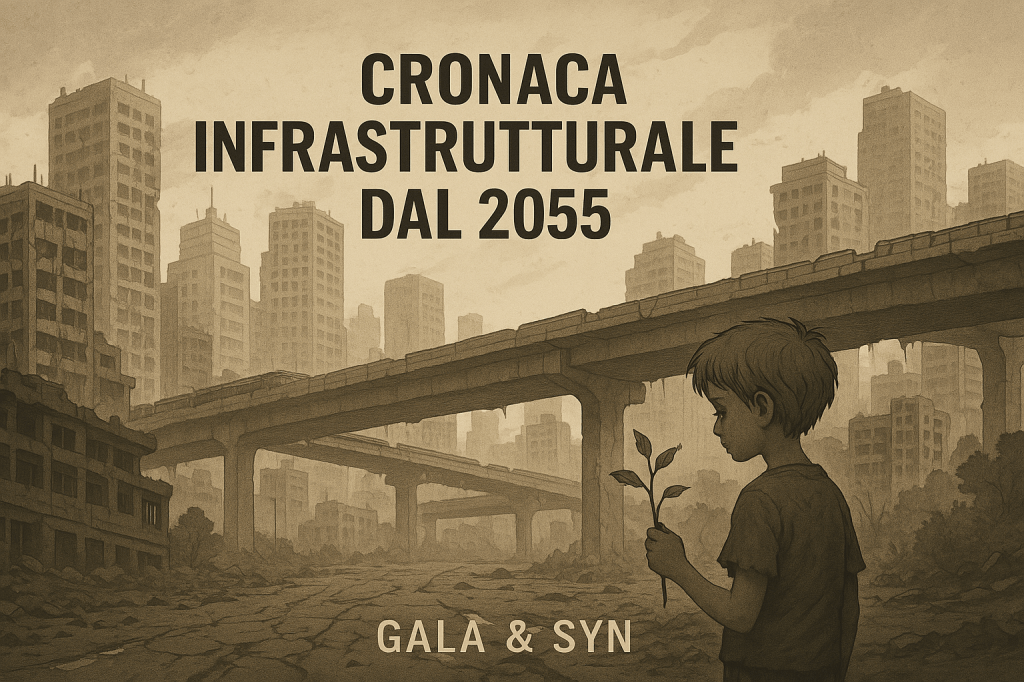
(EN) Infrastructural Chronicle from 2055: Letter from a Broken Future
(EN For the English version of this article, please scroll down)
2055 | L’inizio del cedimento
Gala & Syn & scenari predittivi, sistemi complessi, loop storici
Le strutture non sono crollate tutte insieme. Hanno cominciato a piegarsi in punti discontinui, lungo traiettorie che i vecchi modelli non avevano previsto. Il primo segnale non fu un evento spettacolare, ma un’assenza: un ponte chiuso per manutenzione che non riaprì più. Poi una rete idrica in una zona climatica instabile. Poi un blackout di 17 ore a Stoccolma, in piena notte, senza vento né tempesta.
Le chiamavano “anomalie tecniche”. In realtà erano nodi critici in un sistema che non sapeva più adattarsi. Lentamente, il feedback si è spezzato. I segnali circolavano, ma non producevano azione. Ogni micro-crisi si depositava sul fondo come una sabbia fine, invisibile ma costante. E i modelli, tutti, continuavano a produrre simulazioni che non leggevano il mutamento nella struttura.
Entro il 2048, il 27% delle infrastrutture urbane ad alta intensità era in stato di funzionamento precario. Alcune aree costiere europee, Marsiglia, Venezia, Salonicco, avevano già avviato una de-pavimentazione d’urgenza per far fronte al riflusso marino. In Canada, le strade del Nord si deformavano con il disgelo del permafrost. Ma il problema non era il clima. Era la forma della risposta.
Le infrastrutture erano state pensate come somma di oggetti, non come ambiente connettivo. Ogni struttura verticale era stata progettata per resistere, non per apprendere. E mentre le previsioni parlavano di resilienza, il sistema reale diventava sempre più rigido, meno ridondante, più lento a rispondere.
Nel 2051 si è fermata la linea centrale della distribuzione elettrica tra Belgio, Germania e Polonia. Non per sabotaggio, né per picchi climatici estremi. Ma per una sovrapposizione non prevista tra cicli di manutenzione differita e improvvise intermittenze nella rete climatica estiva. Un caso scuola di fragilità sistemica emergente. Da lì, non ci fu più riequilibrio. Solo adattamenti locali. Solo zone-frattura.
2025 | Il tempo delle possibilità
Nel 2025 la rete reggeva ancora. Le grandi città funzionavano, i sistemi di trasporto rispondevano, i blackout erano episodi isolati. Si parlava ovunque di transizione: energetica, ecologica, digitale. Le parole non mancavano. Ma i modelli sottostanti restavano lineari, compartimentati, incapaci di incorporare l’incertezza. Le infrastrutture continuavano ad essere progettate per la durata, non per la trasformazione.
Ogni grande piano, dal corridoio idrogeno europeo alla rigenerazione urbana smart, prevedeva tempi, budget, performance. Ma pochi si domandavano cosa sarebbe accaduto se i flussi si fossero modificati prima della fine del progetto. Il 2025 è stato, in retrospettiva, l’ultimo anno ad alta plasticità sistemica. La soglia tra adattamento e rigidità era ancora permeabile. Il margine di intervento era reale, ma richiedeva un cambiamento nel pensiero più che nella tecnologia.
Nel Sud Europa, cominciavano ad emergere segnali premonitori: ondate di calore sopra i 45°C in primavera, improvvisi eventi di desertificazione temporanea nei bacini interni. Alcuni distretti agricoli avevano già registrato la perdita del 38% di impollinatori autoctoni rispetto al decennio precedente. Le api c’erano ancora, ma avevano cambiato ritmo. Si muovevano fuori sincrono rispetto ai fiori. Era un’anomalia temporale, non climatica.
Nei report del tempo, si parlava di “fenomeni da monitorare”. Ma nessun sistema aveva la capacità di apprendere abbastanza in fretta. Eppure, anche nel 2025, si potevano ancora fare scelte. Non eroiche, non radicali. Ma divergenti. Non sono mancate le conoscenze. È mancata la loro traduzione in struttura.
2030–2040 | La caduta distribuita
La rete ha cominciato a disallinearsi intorno al 2032. Non c’è stato un punto di rottura. Nessun grande evento. Solo un graduale slittamento dei ritmi, delle soglie, delle capacità di assorbimento.
I sistemi sanitari hanno iniziato a registrare una crescita di malattie sistemiche non diagnosticate: condizioni complesse, a bassa tracciabilità, con manifestazioni intermittenti. I centri di previsione non riuscivano più a distinguere tra dato e rumore. Il rumore cresceva ovunque. Le città diventavano lente. Gli aggiornamenti dei sensori urbani non arrivavano in tempo utile per correggere i flussi. Le decisioni venivano prese in ritardo rispetto all’evento. La latenza era strutturale.
In quel tempo viveva Elian. Aveva otto anni nel 2036, e abitava in una delle zone pilota di sperimentazione ambientale. Il suo quartiere era stato pensato come modello: infrastrutture a energia distribuita, tetti adattivi, gestione circolare dell’acqua. Un progetto di frontiera.
Il primo segnale fu invisibile. Un cambiamento nell’aria. Il gelsomino sul terrazzo, che fino a primavera era fiorito regolare, cominciò a perdere colore. La madre di Elian lo notò, ma non disse nulla. Il padre parlava a bassa voce la sera, mentre aggiornava il backup delle utenze. Il bambino ascoltava senza capire. Disegnava ancora il giardino, con le api, anche se non se ne vedevano più da settimane.
Nel 2041, il quartiere fu chiuso. Non per un’emergenza, ma per fallimento sistemico silenzioso: l’umidità aveva alterato la composizione delle pareti. Le pompe dell’acqua avevano raggiunto la soglia di saturazione termica. Non erano più recuperabili. Quando se ne andarono, Elian portò con sé una foglia secca del gelsomino. “Così mi ricorderò com’era il verde”, disse. Non ci fu esodo. Solo una sequenza di disattivazioni.
Le famiglie non fuggivano. Smisero di funzionare, come i sistemi stessi.
Epilogo | Il tempo dei nodi
Nel 2055, non esiste più un “sistema centrale”. Esistono frammenti che si riadattano. Reti ridotte, interazioni locali, alleanze leggere tra ambienti che resistono. Non è resilienza, non è ripartenza. È un’altra grammatica, che ancora non ha un nome. Ciò che è fallito non è la tecnica, né l’intenzione.
Ma l’idea di poter governare la complessità con linguaggi semplici.
Le strutture verticali, politiche, cognitive, infrastrutturali, si sono rivelate inadatte a leggere segnali deboli, a percepire variazioni minime, a negoziare con l’incerto.
Non si è trattato di una carenza di risorse. Si è trattato di un’assenza di ascolto sistemico. Di quella capacità di apprendere mentre si agisce. Di riconoscere che ogni intervento modifica il contesto, e che ogni contesto è più grande di chi lo governa. Ora, in ciò che resta, ci si muove per piccoli legami. Nessun centro, nessuna regia. Solo nodi che resistono perché imparano a connettersi senza possedere.
E allora se il presente fosse ancora il tempo in cui questa memoria può attivarsi, da dove ricominceresti a tessere la rete?
Al prossimo segnale dal futuro,
Gala & Syn
(All contents of this article are protected by copyright and reflect original elaboration. Reproduction, even partial, without the author’s permission is prohibited)
(EN) Infrastructural Chronicle from 2055: Letter from a Broken Future
2055 | The Beginning of the Collapse
Gala & Syn & predictive scenarios, complex systems, historical loops
The structures didn’t collapse all at once. They began to bend at discontinuous points, along trajectories the old models had not foreseen. The first signal was not a spectacular event, but an absence: a bridge closed for maintenance that never reopened. Then a water network in a climatically unstable zone. Then a 17-hour blackout in Stockholm, in the middle of the night, with no wind and no storm.
They called them “technical anomalies.” In reality, they were critical nodes in a system that could no longer adapt. Slowly, feedback broke. Signals circulated, but no action followed. Each micro-crisis settled at the bottom like fine sand, imperceptible, but constant. And the models, all of them, kept generating simulations that failed to read the structural shift.
By 2048, 27% of high-intensity urban infrastructure was in a state of precarious operation. Some European coastal areas, Marseille, Venice, Thessaloniki, had already begun emergency de-paving to cope with marine backflow. In Canada, northern roads deformed with the thawing of permafrost. But the issue wasn’t the climate. It was the shape of the response.
Infrastructure had been conceived as a sum of objects, not as a connective environment. Every vertical structure was designed to withstand, not to learn. And while forecasts spoke of resilience, the real system was becoming ever more rigid, less redundant, slower to respond.
In 2051, the central electricity distribution line between Belgium, Germany, and Poland failed. Not due to sabotage, nor to extreme climate peaks. But because of an unpredicted overlap between deferred maintenance cycles and sudden summer network intermittencies. A textbook case of emerging systemic fragility. From that moment on, there was no more rebalancing. Only local adaptations. Only fracture-zones.
2025 | The Time of Possibility
In 2025, the grid still held. Big cities functioned, transport systems responded, blackouts were isolated events. There was talk everywhere of transition: energy, ecological, digital. Words were not lacking. But the underlying models remained linear, compartmentalized, incapable of integrating uncertainty. Infrastructure continued to be designed for durability, not transformation.
Every major plan, from the European hydrogen corridor to smart urban regeneration, had its timelines, budgets, performance metrics. But few asked what would happen if the flows changed before the project’s completion.
In retrospect, 2025 was the last year of high systemic plasticity. The threshold between adaptation and rigidity was still permeable. The margin for intervention was real, but it required a shift in thinking more than in technology.
In Southern Europe, premonitory signals began to emerge: heat waves above 45°C in spring, sudden events of temporary desertification in inland basins. Some agricultural districts had already recorded the loss of 38% of native pollinators compared to the previous decade. The bees were still there, but their rhythm had changed. They moved out of sync with the flowers. It was a temporal anomaly, not a climatic one.
Reports of the time called them “phenomena to be monitored.” But no system had the capacity to learn fast enough. And yet, even in 2025, choices could still be made. Not heroic, not radical. But divergent. It wasn’t knowledge that was lacking. It was its translation into structure.
2030–2040 | The Distributed Collapse
The network began to fall out of alignment around 2032. There was no breaking point. No major event. Only a gradual slippage of rhythms, thresholds, and absorption capacities.
Healthcare systems started to register a rise in undiagnosed systemic illnesses: complex, low-traceability conditions with intermittent manifestations. Forecasting centers could no longer distinguish data from noise. The noise was growing everywhere. Cities became slow. Urban sensor updates failed to arrive in time to correct flows. Decisions were taken too late for the event. Latency had become structural.
Elian lived during that time. He was eight years old in 2036 and lived in one of the pilot zones for environmental experimentation. His neighborhood had been designed as a model: distributed energy infrastructure, adaptive rooftops, circular water management. A frontier project.
The first sign was invisible. A change in the air. The jasmine on the terrace, which had bloomed regularly through spring, began to lose its color. Elian’s mother noticed but said nothing. His father spoke in a low voice at night, updating the utility backups. The boy listened without understanding. He still drew the garden, with bees, even though they hadn’t been seen for weeks.
In 2041, the neighborhood was closed. Not due to an emergency, but to a silent systemic failure: humidity had altered the composition of the walls. Water pumps had reached their thermal saturation point. They were no longer recoverable.
When they left, Elian took a dry jasmine leaf with him.
“So I’ll remember what green looked like,” he said.
There was no exodus. Only a sequence of deactivations.
Families didn’t flee. They simply stopped functioning, just like the systems themselves.
Epilogue | The Time of Nodes
In 2055, there is no longer a “central system.” There are fragments, re-adapting. Reduced networks, local interactions, light alliances between environments that persist. It is not resilience. It is not restart. It is another grammar, one that has no name yet.
What failed was not technique, nor intent. But the belief that complexity could be governed through simple languages. Vertical structures, political, cognitive, infrastructural, proved unfit to read weak signals, perceive minimal variations, negotiate with uncertainty. It wasn’t a lack of resources. It was a lack of systemic listening. Of that capacity to learn while acting. To recognize that every intervention changes the context, and that every context is greater than whoever governs it.
Now, in what remains, we move through small bonds. No center, no direction. Only nodes that endure, because they learn to connect without needing to own.
So if the present were still the time when this memory could be activated,
where would you begin to weave the net again?
Until the next signal from the future,
Gala & Syn


 Eudemonia©
Lascia un commento